Blog
Top Powder Coating Equipment Suppliers Worldwide
Choosing reliable Powder Coating Equipment requires more than comparing prices or catalog photographs. A production line may include spray guns, recovery units, curing ovens, booths, conveyors, and inspection tools. Each component affects transfer efficiency, finish consistency, energy use, and maintenance time. A supplier’s real value appears during installation, color changes, troubleshooting, and staff training.
Randy Priest, a former president of the Powder Coating Institute, has said, “Powder coating is both an art and a science.” That observation remains practical. Experienced operators watch powder flow, grounding, film thickness, oven temperature, and surface preparation. A small grounding problem can create uneven coverage on a steel panel. An oven reading may look correct while the part temperature remains too low. Details matter.
This guide examines leading global suppliers through a practical lens. It considers equipment quality, technical support, customization, spare-parts availability, energy performance, and documented customer experience. Established brands deserve attention, but reputation alone is not proof. Some smaller manufacturers offer responsive engineering and thoughtful solutions for regional production needs. Others may promise more than they can support.
The comparison is not perfect. Supplier data can change. Marketing claims also require verification. Buyers should test samples, request performance records, and evaluate total ownership costs. The strongest Powder Coating Equipment partner is not always the largest company. It is the supplier that understands your materials, production volume, finish requirements, and future constraints.
What Powder Coating Equipment Suppliers Provide
Top Powder Coating Equipment Suppliers Worldwide
What Powder Coating Equipment Suppliers Provide
A capable powder coating equipment supplier provides more than a spray gun. They assess part size, coating volume, powder type, and available floor space. Their recommendations may include spray booths, automatic or manual guns, powder hoppers, and recovery units. A well-designed booth controls overspray and keeps color changes cleaner.
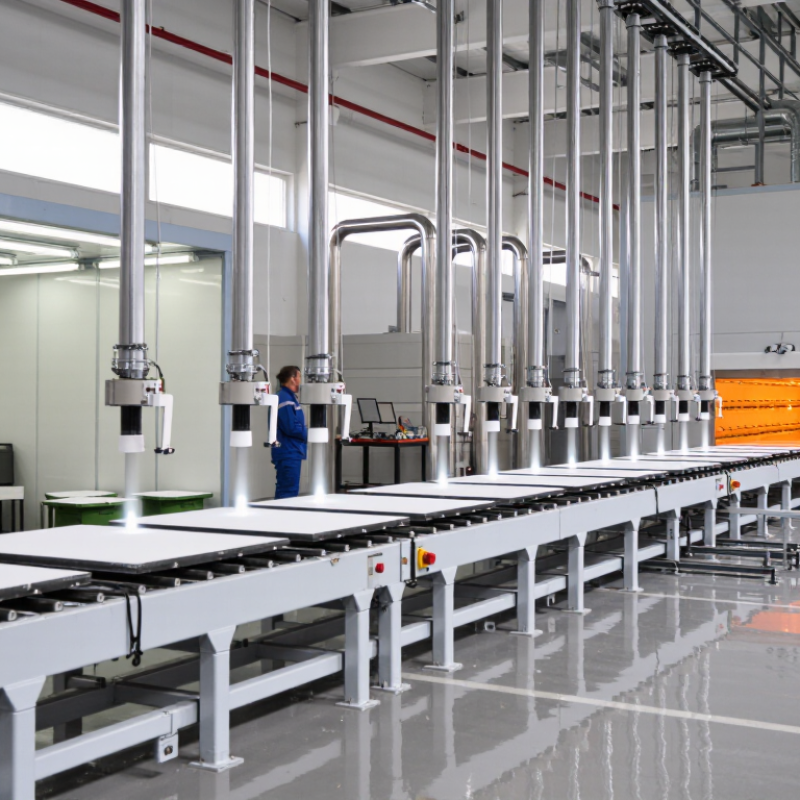
Suppliers also provide curing ovens, conveyors, control panels, and temperature monitoring tools. Oven design matters because uneven heat can cause weak adhesion, dull finishes, or wasted powder. Reliable suppliers explain airflow, heating capacity, grounding, and routine inspection requirements in practical terms. They should also offer installation support, operator training, spare parts, and maintenance guidance.
Shop-floor trials often expose gaps in a quotation. A system may look efficient on paper but feel awkward beside a real production line. Small details matter, such as hose length, filter access, gun balance, and cleaning time. One weakness in many supplier proposals is limited attention to future product changes. A thoughtful supplier leaves room for different part dimensions and coating colors. Still, no equipment package solves every problem. Operators must record film thickness, oven temperature, powder usage, and defect patterns. Those records support safer adjustments and more consistent results. Suppliers that provide testing, documentation, and responsive technical service are easier to evaluate over time.
Key Equipment Types and Selection Criteria
Selecting powder coating equipment requires more than comparing advertised output. A practical line may include spray guns, a booth, powder recovery, a curing oven, and a conveyor. Each part must match the workpiece size, coating chemistry, and daily production volume. In plant trials, operators often notice small problems first. Poor grounding can cause uneven coverage. Weak airflow can leave powder on booth walls.
The spray gun should offer stable voltage control and comfortable handling during long shifts. Check transfer efficiency, powder compatibility, cleaning time, and spare-part availability. The booth needs suitable airflow, accessible filters, and safe powder collection. A recovery system can reduce waste, but complex systems may demand more maintenance. Keep that trade-off visible.
Oven selection depends on temperature accuracy, heat distribution, and loading patterns. A larger oven is not always better. It may consume more energy and create uneven heating when partly loaded. Ask suppliers for temperature mapping data, line-speed calculations, installation requirements, and operator training. Confirm electrical standards, ventilation needs, and service coverage in your region. A test panel can reveal more than a polished brochure. Supplier claims still need verification.
Leading Global Supplier Categories and Market Coverage
Top Powder Coating Equipment Suppliers Worldwide
The global powder coating equipment market includes several supplier categories. Full-line manufacturers provide spray guns, booths, curing ovens, conveyors, and recovery systems. Specialized suppliers focus on individual components, such as automatic guns, powder pumps, or temperature controls. Regional engineering firms often design custom lines for furniture, automotive parts, appliances, and architectural panels.
Market Coverage
Market coverage varies widely. Large international suppliers usually support multiple regions through service centers, technical teams, and spare-parts warehouses. Their equipment may suit high-volume factories with standardized production. Regional suppliers can respond faster to local installation needs and offer practical modifications. However, their overseas support may be less consistent.
Buyers should check technician availability, response times, training options, and replacement-part storage before signing a contract.
Real Factory Experience
Real factory experience matters. A reliable supplier should explain transfer efficiency, booth airflow, oven temperature uniformity, and coating thickness control with measurable data. Site references can reveal problems that brochures omit. Ask for test panels using the intended powder and substrate. Small details matter, including filter access, gun cleaning time, and control-panel language.
Choosing the Right System
Not every advanced system fits every plant. A compact workshop may lose money with oversized automation. Energy use can also change operating costs significantly. Supplier claims deserve careful testing. Market coverage is useful, but local service quality often decides whether production stays stable. Temperature drift happens. Plans should account for it.
How to Compare Supplier Quality, Support, and Pricing
Choosing powder coating equipment requires more than comparing quotation totals. Grand View Research reported that the global powder coatings market reached approximately USD 15.18 billion in 2023. Growing demand increases supplier choices, but quality differences remain easy to miss. Request coating uniformity records, transfer-efficiency results, temperature mapping, and spare-parts specifications. A stable film should look consistent across panel edges, corners, and recessed areas. Ask for test samples using your actual substrate and powder.
Support matters. Insist on documented installation procedures, operator training, response-time targets, and remote troubleshooting access. The International Organization for Standardization’s ISO Survey shows millions of certified management systems worldwide, yet certification alone cannot prove technical competence. Check whether technicians understand curing windows, grounding, booth airflow, and powder recovery. Request references from facilities with similar production volumes. Short answers are warning signs.
Price can mislead. Compare five-year ownership costs, including filters, electricity, compressed air, maintenance, downtime, and consumable wear. A lower initial quote may hide expensive manual adjustments. The U.S. Department of Energy identifies compressed-air systems as a significant industrial energy-use area, making air consumption an important comparison point. I still question overly precise payback promises. Factory conditions change. Ask suppliers to show calculation assumptions, measurement methods, and excluded costs. A practical evaluation may include a witnessed production trial, not only polished brochures.
Top Powder Coating Equipment Suppliers Worldwide - How to Compare Supplier Quality, Support, and Pricing
Independent comparison of common supplier profiles and prevailing equipment-market benchmarks
| Supplier profile | Typical operating region | Typical equipment scope | Quality indicators to verify | Automation level | Typical project lead time | Typical warranty | After-sales support | Indicative equipment investment | Best fit |
|---|---|---|---|---|---|---|---|---|---|
| Entry-level modular supplier | Asia, Middle East, Africa, and cost-sensitive export markets | Manual booths, batch ovens, cartridge filters, reciprocators, and basic conveyor sections | Material thickness, weld quality, airflow test, electrical documentation, spare-parts list, and factory acceptance test | Manual to semi-automatic | 4–10 weeks for standard modules; longer for customized lines | Usually 12 months for manufacturing defects | Remote commissioning, video support, and paid on-site service where available | US$15,000–80,000 | Small workshops, prototypes, job shops, and low-volume production |
| Standard batch-system supplier | Worldwide, especially small and medium manufacturing markets | Batch booth, batch oven, powder recovery, gun package, loading stations, and controls | Temperature uniformity, coating-thickness consistency, filter efficiency, control-panel labeling, and documented commissioning | Semi-automatic | 6–14 weeks | 12 months; component exclusions should be stated clearly | Installation manuals, operator training, remote diagnostics, and stocked wear parts | US$40,000–150,000 | General industrial parts, agricultural components, furniture, and metal fabrication |
| Continuous conveyor-line supplier | North America, Europe, East Asia, and established industrial hubs | Pretreatment, drying oven, spray booth, curing oven, conveyor, recovery, and automated controls | Line-balance calculations, oven mapping, conveyor-load design, airflow readings, safety circuits, and documented process validation | Semi-automatic to fully automatic | 12–28 weeks, depending on engineering and site preparation | 12–24 months on major equipment; consumables typically excluded | Site installation, commissioning, training, preventive-maintenance plans, and service contracts | US$150,000–750,000 | Medium-volume production with repeatable part families |
| High-throughput integrated-line supplier | Europe, North America, Japan, South Korea, and advanced manufacturing regions | Multi-stage pretreatment, automated spray system, cyclone or cartridge recovery, curing oven, conveyor, and production monitoring | Validated process windows, energy-performance data, PLC documentation, safety compliance, repeatability testing, and acceptance criteria | Fully automatic | 20–40 weeks | 12–24 months, often linked to maintenance conditions | 24/7 support options, remote monitoring, field technicians, training, and lifecycle upgrades | US$500,000–2,000,000+ | Automotive, appliances, HVAC, construction products, and other high-volume operations |
| Specialty heavy-component supplier | North America, Europe, Australia, and heavy-industry export markets | Large booths, heavy-load conveyors, oversized ovens, shot blasting, pretreatment, and corrosion-resistant systems | Structural calculations, load testing, oven recovery performance, corrosion protection, access provisions, and safety interlocks | Manual to fully automatic | 16–36 weeks | 12–24 months for major fabricated equipment | On-site engineering, installation supervision, scheduled inspections, and custom spare-parts programs | US$250,000–1,500,000+ | Heavy machinery, trailers, structural steel, rail components, and large fabricated parts |
| Clean-process and recovery-focused supplier | Europe, North America, and environmentally regulated industrial markets | High-efficiency booths, powder recovery, reclaim management, low-emission ovens, filtration, and process monitoring | Powder-recovery rate, filter performance, energy consumption, emissions documentation, grounding checks, and waste-reduction records | Semi-automatic to fully automatic | 14–30 weeks | 12–24 months depending on system scope | Process audits, energy reviews, operator training, remote support, and scheduled optimization | US$180,000–900,000+ | Facilities prioritizing powder utilization, energy efficiency, and environmental performance |
| Turnkey engineering integrator | Worldwide, with local partners or regional service teams | Complete line design, civil-layout coordination, pretreatment, application, ovens, conveyor, controls, installation, and validation | Detailed user requirement specification, risk assessment, performance guarantee, FAT/SAT records, documentation package, and change-control process | Project-specific; commonly fully automatic | 24–52 weeks | 12–24 months, with optional extended service agreements | Single-point project management, site supervision, training, validation, spare parts, and long-term service | US$750,000–5,000,000+ | New factories, major expansions, regulated production, and multi-process installations |
| Retrofit and modernization specialist | Local and regional industrial service markets worldwide | Controls upgrades, gun replacement, booth modification, oven refurbishment, conveyor changes, filtration, and recovery improvements | Baseline-versus-upgrade measurements, compatibility review, electrical drawings, downtime plan, safety assessment, and documented performance gains | Existing-system dependent | 2–16 weeks for defined upgrades | Typically 6–12 months on supplied components and workmanship | Fast troubleshooting, planned shutdown support, replacement parts, and maintenance contracts | US$10,000–300,000+ | Existing lines needing higher throughput, improved finish consistency, or lower operating cost |
Recommended supplier-scoring framework
Pricing ranges are indicative capital-equipment benchmarks in U.S. dollars and generally exclude building work, freight, taxes, utilities, installation by third parties, powder materials, and ongoing maintenance.
Procurement Steps for Powder Coating Equipment worldwide
Top Powder Coating Equipment Suppliers Worldwide
Procurement Steps for Powder Coating Equipment Worldwide
A reliable purchase starts with a precise production brief. Define part dimensions, coating type, hourly output, color changes, and available floor space. Record oven length, conveyor speed, electrical capacity, and ventilation needs. Small details matter. Ask suppliers for utility loads, equipment drawings, cycle times, and powder recovery rates. Use actual workpieces, not only catalog specifications, when discussing capacity.
Compare suppliers through technical evidence and practical verification. Request recent project references from similar industries and inspect their equipment through a factory visit or live video call. Review spray-gun performance, booth airflow, filter access, curing uniformity, safety interlocks, and control-system documentation. Obtain a complete landed-cost quotation, including packaging, freight, installation, training, spare parts, and local service. Check destination-country electrical, safety, import, and environmental requirements with qualified professionals.
Before signing, run a sample test with your own parts and powder. Measure film thickness, adhesion, appearance, cure temperature, and recovery efficiency. Put measurable acceptance criteria into the contract. Specify delivery milestones, training hours, warranty coverage, and response times for technical support. A polished quotation can still hide installation delays. I have learned that early assumptions often fail when floor conditions or power quality differ. Leave contingency time and budget. That is not excessive caution. It is practical procurement.
Global Powder Coating Equipment Procurement Timeline
This planning benchmark shows the typical number of weeks allocated to each major procurement stage, from defining technical requirements to installation and commissioning. International shipping and customs clearance commonly require the longest single period, while supplier qualification, technical review, and commercial negotiation should be completed before placing the purchase order.

