

Sanitary Material Handling and Hygienic Equipment
Who Are the Top Lifting Equipment Manufacturers in China?
China’s lifting equipment sector serves construction sites, ports, factories, and energy projects. Choosing a manufacturer requires more than comparing rated capacity or price. Buyers should examine design experience, production controls, component traceability, service coverage, and documented load testing. Small details matter: a clearly marked nameplate, an accessible inspection record, and a realistic delivery schedule can reveal more than a polished catalogue.
Demand for material-handling systems is supported by China’s industrial scale. The International Federation of Robotics’ World Robotics 2024 report recorded 276,288 industrial robot installations in China in 2023, about 51% of global installations. This figure is not a direct measure of lifting equipment sales. It does, however, show the scale of factory automation, where cranes, hoists, and related systems often support production flows. For trade comparisons, UN Comtrade classifies many cranes and lifting appliances under HS 8426, giving researchers a consistent starting point for examining international shipments.
No single public ranking reliably identifies China’s “top” manufacturers across every equipment category. That deserves caution. A company strong in tower cranes may not lead in overhead cranes or electric hoists. This guide compares manufacturers through product focus, engineering capability, export experience, quality evidence, and after-sales support. It also highlights where public data is limited, because a confident ranking can still hide important gaps.
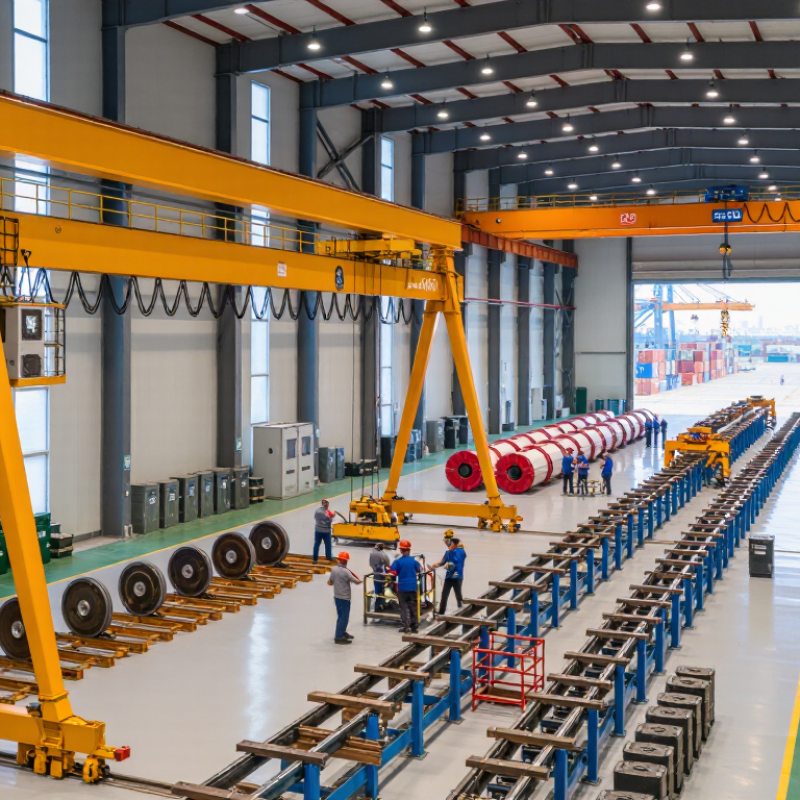
China’s Lifting Equipment Sector: Market Size, Output, and 2024 Growth
China’s lifting-equipment market sits within a much larger construction-machinery industry, so sector-wide figures should not be mistaken for crane sales alone. The China Construction Machinery Association’s 2024 industry review reported total operating revenue of about RMB 2.7 trillion, roughly 3% above 2023. That figure includes equipment beyond lifting machinery. It offers scale, not a precise crane-market valuation.
Output is harder to compare. Official statistics group products by equipment type, and cranes may be counted by units or lifting capacity. The National Bureau of Statistics reported that infrastructure investment grew 4.4% in 2024, while manufacturing investment rose 9.2%. Both can support demand for cranes at building sites, factories, and logistics hubs. Demand was uneven. A busy plant may add overhead cranes, while a project contractor needs mobile units on temporary ground. The growth picture is positive, but not uniform.
Export activity also matters. The association’s review described continued strength in construction-machinery exports, though that broad measure does not isolate lifting equipment. For buyers, the practical signals are production lead times, rated-load testing, and spare-part availability—not headline growth alone. Output statistics remain imperfect, and that limitation deserves attention when comparing market forecasts.
China’s Lifting Equipment Sector: Market Size, Output, and 2024 Growth
| Indicator | 2024 figure or status | Coverage and interpretation | Source / data note |
|---|---|---|---|
| Standalone national market size for lifting equipment | Not separately reported in the cited national statistical release | There is no single official, consolidated market-value figure for all lifting equipment in this release. Commercial estimates may vary according to whether they include cranes, hoists, elevators, components, and related services. | National Bureau of Statistics of China (NBS), Statistical Communiqué on the 2024 National Economic and Social Development |
| Standalone national output volume for all lifting equipment | Not reported as one combined product category in the cited release | Equipment types are classified and counted separately; a combined total should not be inferred without a defined product scope and consistent units. | NBS, Statistical Communiqué on the 2024 National Economic and Social Development |
| Real GDP growth | 5.0% | Year-over-year growth for China’s economy in 2024; this is macroeconomic context, not a lifting-equipment growth rate. | NBS, Statistical Communiqué on the 2024 National Economic and Social Development |
| Industrial value-added growth | 5.8% | Year-over-year growth for industrial enterprises above designated size in 2024; it is not specific to lifting equipment. | NBS, Statistical Communiqué on the 2024 National Economic and Social Development |
| Manufacturing value-added growth | 6.1% | Year-over-year growth for manufacturing in 2024; it provides broad sector context rather than a lifting-equipment market estimate. | NBS, Statistical Communiqué on the 2024 National Economic and Social Development |
| Equipment manufacturing value-added growth | 7.7% | Year-over-year growth for the equipment manufacturing category in 2024. This category is broader than lifting equipment. | NBS, Statistical Communiqué on the 2024 National Economic and Social Development |
Data note: Official national statistics do not provide a single market-size or output total for the full lifting-equipment sector in this release. The reported growth rates are economy-wide or broader manufacturing indicators and should not be presented as lifting-equipment-specific growth.
Related Posts
-
How to Choose the Right Manual Handling Lifting Equipment for Safety?
-
How to Choose the Right Lifting Equipment for Your Needs?
-
Top 10 Manual Handling Lifting Equipment for Global Buyers
-

10 Essential Tips for Choosing the Right Industrial Lifting Equipment
-

How to Choose the Right Lifting Gear for Your Needs?
-
How to Choose the Best Lifting Equipment for Your Needs?